Showing posts with label Math Menu Ideas. Show all posts

Tuesday, January 26, 2016

Transformation Tuesday: Menus- 20-50-80 Menu

Today's math menu is called a 20-50-80 menu (as termed in the book Differentiating Instruction with Menus) because the tasks are assigned a 20-point, 50-point, or 80-point value. A sample 20-50-80 menu is shown in the image below. 
This image illustrates the actual 20-50-80 menu.
This image illustrates the product guidelines and requirements.
How to Use It

For this menu, students choose two activities to complete from the list totaling 100 points. The menu includes two 20-point tasks, four 50-point tasks, and two 80-point tasks. Because of its structure, students must choose one 20-point task and one 80-point task or two 50-point tasks. 

Advantages

This menu seems must appropriate for a short period of time. Because the choices are focused on just one unit of study, students may be able to complete it during one school week if they are given dedicated time periods to complete it. 

In addition, because of its structure, students are forced to complete one 20-point task and one 80-point task or two 50-point tasks. This provides you with the opportunity to navigate which activities students complete. For example, in the menu above, all of the 20-point activities are coordinate plane tasks; however, the 80-point activities are graphing tasks. You'll also notice that there is one required 50-point activity. This ensures that students complete at least one coordinate plane and one graphing task.  

Disadvantages

This menu is not as complex as the others and may be limited in the differentiation options and tasks available to students. Because of its structure, unlike the other menus, students will complete, at most, one higher-level thinking activity. Additionally, this menu does not offer a free-choice option. 


To Create this Menu

Using the format described above, create a bulleted list with two 20-point tasks, four 50-point tasks, and two 80-point tasks. 

Sound Off! What type of menus do you use in the classroom?

Thursday, September 3, 2015

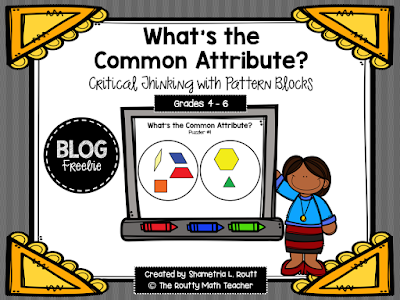
Thursday Tool School: Critical Thinking with Pattern Blocks


One the most common things I hear from teachers is about not knowing how to best utilize manipulatives. Many schools have a variety of manipulatives ready to be used, but they often go unused because teachers are unsure of how to use them to their fullest potential. Look no further. I'm got something special for you! 

Thursday Tool School will feature various math manipulatives that are common in schools. This weekly post will provide ideas for ways to get the most out of the tools. I will feature a new manipulative each month, so be sure to stay tuned. This month's featured manipulatives are pattern blocks. 

Pattern blocks. I know what you're thinking. When you inherited your classroom, there were gobs of these random shapes, maybe even a few buckets of them. You thought to yourself, "What am supposed to do with these? We only teach geometry and shapes for three weeks!" Well, did you know that pattern blocks can be used for more then just your three-week geometry unit? Pattern blocks can be used all year long! 

Here's a short explanation of the purpose of pattern blocks. A set of pattern blocks contains six basic shapes: a yellow hexagon, a red trapezoid, a blue rhombus, a green triangle, an orange square, and a beige rhombus. The pieces are proportional to each other which extends the number of ways in which they can be used. In addition to analyzing the characteristics of two-dimensional shapes, they can also be used to teach fractions. How's that for a non-standard fraction visual!

Today's activity involves critical thinking with pattern blocks. This activity can be used year round and makes a great starter activity, especially during that three-week geometry unit. The only prerequisite skills needed are some basic vocabulary terms related to shapes, i.e. sides, angles, congruent, equal, etc. 

Here's how the activity works:
1. Display the puzzler on a white board or wall.
2. Ask the students, "What's the common attribute?"
3. Provide think time.
4. Ask students to "turn and talk" to a shoulder partner, face partner, neighbor, or classmate to discuss the answer. 
5. Have students share their responses with the class. 

Important questions to ask: 
a. What vocabulary is important here?
b. What's the common attribute of the left side?
c. What's the common attribute of the right side?
d. What's the common attribute of the shapes in the middle, or the intersection, of the two circles? 
e. Why is there a shape on the outside of both circles? What does this mean? (It is a part of the set but does not meet the inclusion criteria for either circle.)


Once students get the hang of the activity, have them create their own puzzlers-- great menu activity. Using their creations, you validate your students as mathematicians and sense makers and expand your pool of puzzlers. 


Free Resource Alert: Grab a free pack of these puzzlers to get you started here or click the picture above. 


An InLinkz Link-up
This is a part of The Best of Teacher Entrepreneurs Marketing Cooperative's November Teacher Talk Link-Up


Thursday, October 30, 2014

Doing Math the Routty Way: Engaging Activities from A to Z (Day 23)

X-word Puzzles- Crossword puzzles are a fun and motivating way to practice important skills and content. There’s something about the puzzle aspect of this task that is appealing to students. Crossword puzzles can be created to assess a variety of skills. They are easy to make and the students love them! 

Check out these student created puzzles!

Resources to Get You Started: 
  • The Armored Penguin Crossword Puzzle Maker is an excellent teacher resource for creating crossword puzzles. The program is free and allows you to create a puzzle as a PDF or you can copy and paste the puzzle into another document, such as Microsoft Word or PowerPoint. 
  • The free puzzle maker at Discovery Education is an easy tool for students to use to create their own puzzles. Student-created puzzles can be added to math menus or used as fast finisher challenges (see the picture above). The students love creating them and seeing their classmates try to complete them!
There are many ways to use crossword puzzles. Try taking a worksheet that has numerical answers that can be represented with a single word and converting the task into a crossword puzzle. For example, in the puzzle below, students simplify each numerical expression and write the word form of each number to complete the puzzle. 


This crossword puzzle is part of my Order of Operations Pack at my Teachers Pay Teacher store. 

Tuesday, September 23, 2014

Doing Math the Routty Way: Engaging Activities from A to Z (Day 12)

Menus- Menus are a great way to add some challenge and pizzazz to your everyday curriculum. Menus can be created for a variety of purposes and include a variety of activities. 

Last year, I had a group of fifth graders that I had the opportunity to teach in fourth grade. Since I'd had them for a full school year, I really wanted to crank up the learning expectations in the classroom. I had a lot of fast finishers. I decided to channel their energy by using math menus. 

The basic idea was that they would receive one menu for each nine-week grading period. They would have the entire nine weeks to complete the menu board, or choice board as I sometimes called them. When they completed the board, they received a homework pass. (I know some of you are saying that you would not want them to skip doing their homework, but the amount of work and thinking required to complete the menu far exceeded what was required to complete the weekly homework.) 

What was on the menus? I used a book as a guide for creating really great menus. It's called Differentiating Instruction with Menus (click the link to find out more about it). It has templates for a variety of menus and product ideas as well. I typically utilized the book for the menu templates and the product ideas to create activities for the skills the students would learn during each nine-week period. I tailored the menus to emphasize critical thinking skills and reinforce fifth grade content. 

Here are two examples of the menus that I used with my students. The second page of each menu gives product guidelines and requirements. You will notice references to puzzles and Marcy Cook Bags. I will discuss my Puzzle Box in a later post. The Marcy Cook bags involve the tiling tasks that I talked about last week.     

This is a choice board. To complete this board, students needed to complete all of the activities in a column, row, or diagonal. 

This is a game show menu. In order to complete this board, students needed to earn a total of 65 points with at least one activity from each category or earn a total of 100 points with at least one activity from each category. The number of points earned determined whether the student received a single-subject homework pass or an all-subject homework pass. 
 

Here are some samples of the products created by the students. 


Wednesday, September 10, 2014

Doing Math the Routty Way: Engaging Activities from A to Z (Day 8)

I Have, Who Has?- If you are not familiar with this activity, it is a class activity where one student starts the process and, in turn, each student answers a question and then asks a new question until the person who asked the first question answers the last one. It’s one big loop!

My favorite set is a set I found at a math conference that had four problems on one card. That gave me four chances to use the same set of cards. The operations on the cards were basic, but that gave me the opportunity to use it several times throughout the year. I even used it as a transition to another activity or as a brain break between subjects. The students absolutely loved the activity and would ask for it often. When I challenged them to see how fast they could complete the loop, it became even more popular!

Since my students loved the activity so much, I started including it on their math menus. Student-created card sets are usually challenging and can be designed for many different skills. It also makes for a great fast finisher activity.

Want to get started now? Check out my “I Have, Who Has: Monster Operations” card set at my Teachers Pay Teachers Store. It includes four multi-step problems on each card. See the preview below. 


I also included a picture of a set of student-created cards as an example for you. See the photo below. Enjoy!

Tuesday, August 26, 2014

Doing Math the Routty Way: Engaging Math Activities A to Z

Hello!
I'm starting a new series today sharing ideas and strategies for how to create an engaging math classroom. Subscribe to my blog or follow my blog by email to get my latest post. Read on to see the first two letters! Enjoy!


After Math- Students are always asking what math has to do with real life. The “After Math” activity will provide an opportunity for students to investigate how math relates to their world “after math” is over. This activity can be used in multiple ways and can be repeated throughout the year. It would also make a great menu item.
Assign students a topic to investigate (see examples below). Students can find artifacts in magazines, newspapers, clipart collections, on internet safe sites for kids, or simply draw a picture. After they find an artifact, have the students complete an “After Math” sheet to describe their artifact. Then, create a bulletin board to showcase how math is used outside of school. Here are some ideas for “After Math” investigations:
• occupations that use math
• newspaper articles using math
• math around your home
• examples of problem solving in everyday life

Go to my "File Cabinet" page and click "Engaging Math Activities" or click here for a copy of the "After Math" activity page.


Book Activities- Amy Axelrod has several math-related picture books. Her pig series books about a family of pigs are a great way to integrate math with literature. Many of the books in this series include math stories where the students can solve the pigs’ problems right along with them. The books also include an overview of the math in each book.
Use the book to write questions to go along with the story. Place the book and the activity sheet at a station or include it in a math menu and let the students find the solution to the pigs’ problem.

Go to my "Freebies" page or click here for a copy of the "Pigs Will Be Pigs" story questions.