Wednesday, February 18, 2015

Math Picture Books to Love: If You Hopped Like a Frog


If You Hopped Like a Frog by David Schwartz

  • Target Skill(s): Ratios and Proportions
  • Book Synopsis: This book has a series of statements relating the abilities of an animal to that of a human if we had the same ability (proportionally). For example: 
    • "If you hopped like a frog, you could jump from home plate to first base in one mighty leap!"
    • "If you ate like a shrew, you could devour over 700 hamburgers in a day!"
  • Math Involved: The author uses proportional reasoning to relate animal abilities to what humans could do with the same abilities. 
  • Questions to Ponder:
    • How do you think the author created these statements? Prove how they are possible.
  • Activity Ideas:
  • Book Link on Amazon: http://bit.ly/IfYouHoppedLikeAFrog


Tuesday, February 17, 2015

Math Picture Books to Love: Sir Cumference and the Great Knight of Angleland


Sir Cumference and the Great Knight of Angleland by Cindy Neuschwander
  • Target Skill(s): Identify Acute, Right, Obtuse, and Straight Angles; Measure Angles, Identify Parallel Lines
  • Book Synopsis: Radius, son of Sir Cumference and Lady Di of Ameter, wanted to be a knight. He practiced every day until his teacher said he was ready for his first quest. Radius then set out with a medallion given to him by his parents. While on his quest, Radius stumbled upon an old castle with a note attached to the door. On the note was a riddle with directions to reach a kidnapped King. With his horse, Radius used his medallion (a protractor) to find the correct angles and the right paths to take to find the King. Radius saved the King and received his knighthood. 
  • Math Involved: This books reinforces how to use a protractor to measure angles and emphasizes the use of geometric vocabulary to identify angles (right, acute, obtuse, and straight) and types of lines.
  • Questions to Ponder:
    • What are the four types of angles? Describe each.
    • What are parallel lines? 
    • What tool do we use to measure angles?
    • How do you measure angles?
    • What are degrees?
  • Activity Ideas: 
    • Create a medallion protractor for each student (some of the books include this). Have the students use the medallions to measure various angles. 
    • Have students find and identify examples of angles around the classroom. 
    • Provide students with angles to measure. Have students sort the angles into groups of knightly right, big, straight, and slight angles (like Radius's angles in the story).  
  • Book Link on Amazon: http://bit.ly/SirCumferenceGreatKnightofAngleland

Saturday, February 14, 2015

Deep in the Heart of Texas Blog Hop


Welcome to the "Deep in the Heart of Texas" blog hop!  Over 40 Texas teacher bloggers have joined together to share what we love about our state as well as ideas and freebies that we love.  You will also have the opportunity to enter to win TpT products and/or TpT gift certificates by entering using the rafflecopters included in each post.  Down at the bottom, you will see all of the blogs participating in the hop.  Just click and you will be taken to their posts.  We hope you love what you find.  Happy Valentine's Day!


I'm a native Texan. I have lived in Texas for my entire life-- and at this time, I never plan to leave! I grew up in Austin but went to K-12 school in Pflugerville ISD. After graduating from high school in 1998, I completed my undergraduate work at Baylor University in Waco. When I finished my Elementary Education teaching credentials at Baylor, I began teaching fourth grade in 2002 in Pflugerville ISD. Oddly enough, I ended up teaching with my fourth grade teacher-- yes, it was very odd. At the same time, I began working on my Masters degree in Curriculum and Instruction at the University of Texas at Austin. 

In 2007, I began working on my Principal certification credentials at Concordia University in Austin. Upon finishing the program in 2008, I accepted an Assistant Principal position in Leander ISD. During the year, I decided that I really enjoyed the creative aspects of education more than the administrative side, so I returned to the classroom and began to focus on designing curriculum. 

In 2012, I began working on my doctorate degree in Mathematics Education at Baylor University. This path has really given me an in-depth view of the world of math. This journey actually inspired me to begin creating products for teachers and blogging about mathematics teaching and learning. 

While I have taught grades four, five, and seven over the years, I am currently a mentor teacher for first and second year teachers. This new position has given me the opportunity to support the learning of teachers early in their careers and gain knowledge in a variety of new areas, including early grades mathematics. 


I absolutely love living in Austin! The great weather and eclectic feel of the city makes this a very unique place to be-- as confirmed by the many non-natives who move here each year. My favorite things about Austin include the weather, the lakes, the unique variety of cuisine, and the luscious parks and rolling hills of green.


An activity I love is a vocabulary strategy called Swat-It! This has been my class' favorite way to review vocabulary for years! It's a great way to get the students to learn important vocabulary words. It's both engaging and fun and all of the students want to volunteer to be a swatter. 

Check out a sample Swat-it! board below!


Here's how to set it up: 
1. Use an 8.5 inch x 11 inch size paper to program a 3 x 3 unit rectangle with 9 vocabulary words.  
2. Project the rectangle onto your classroom whiteboard so that the students can reach all of the rectangles with a fly-swatter. 
3. Ask for two volunteers to come to the front of the room and stand on the left and right side of the Swat-it! board. 
4. Hand each student a fly-swatter. 
5. Read a definition. 
6. The students use the fly-swatter to swat the word that matches the definition. 
7. The first student to swat the correct word is the winner. 

Variations: Instead of vocabulary words, use numerical answers and read number sentences.

Note: I featured this activity in my "Engaging Mathematics" series last fall. Click the link to check it out!


One of my favorite freebies is my "Math Starters" pack. (Click the link to download the pack.) I shared it as part of my  

"Math with Ms. Routt" series last month (click the link above to view the series). A math starter is a critical thinking activity that incorporates grade level content and skills. This pack includes three critical thinking activities that can be used to engage your students in the first few minutes of your math class. Be sure to check it out. 

You can find other resources and freebies in my "File Cabinet." (Click the link to view.) It's a work in progress, but I am continually working to add new resources. My critical thinking and problem solving freebies have been very popular! Happy Hunting!

Friday, February 13, 2015

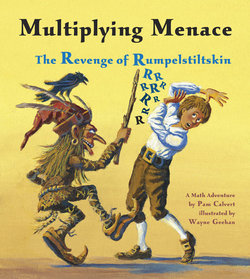
Math Picture Books to Love: Multiplying Menace- The Revenge of Rumpelstiltskin

Multiplying Menace- The Revenge of Rumpelstiltskin by Pam Calvert
  • Target Skill(s): Multiplication of Whole Numbers and Fractions
  • Book Synopsis: Peter, son of the King and Queen, is celebrating his tenth birthday when Rumpelstiltskin returns to fulfill the promise made to him by the Queen when he spun her straw into gold. When the Queen refuses, Rumpelstiltskin reeks havoc on the town. All through the town, Rumpelstiltskin points his magic stick at all people and things. Poof! They disappear! After Rumpelstiltskin gives the King six noses, Peter agrees to go with him if Rumpelstiltskin agrees to fix the town. Rumpelstiltskin takes Peter to his home and Peter watches as he uses his magic stick to create more of the things he needs and less of what he doesn't need. While Rumpelstiltskin is sleeping, Peter takes the magic stick and tries to figure out how to use it. Once Peter discovers the secret of the magic stick, he returns to the town to fix Rumpelstiltskin's work. 
  • Math Involved: In the story both Peter and Rumpelstiltskin use the magic stick to multiply whole numbers by whole numbers to obtain a larger amount and whole numbers by fractions to obtain a smaller amount. 
  • Questions to Ponder:
    • What is multiplication?
    • What happens when we multiply by a whole number by a whole number?
    • What happens when we multiply a whole number and a fraction?
    • What happens when we multiply a number times zero?
  • Activity Ideas:
    • Elementary students are used to seeing multiplication as a way to get more of something. Create a T-chart and brainstorm situations from the text when more objects resulted and when less objects resulted. Use the book as a guide. Discuss what kind of numbers Rumpelstiltskin and Peter multiplied by to get more and to get less. 
    • Have students create a chart with an example of multiplication with whole numbers and fractions. (See the chart above.)
    • Use the book to create problems such as, "When Peter wanted to change his dad's face back to one nose instead of six, what did he multiply by?" Have students write and illustrate a number sentence to match the problem. 
  • Book Link on Amazon: http://bit.ly/MultiplyingMenace

Thursday, February 12, 2015

Math Picture Books to Love: Cut Down to Size at High Noon


Cut Down to Size at High Noon  by Scott Sundby

  • Target Skill(s): Scaling, Scale Factor, Proportions, Enlargements, Reductions
  • Book Synopsis: Louie Cutorze is the only haircutter in the town of Cowlick.His unusual creations are the pride and joy of the  town. Louie uses scale drawings to create a smaller version of a life-size object and then sculpts his artwork onto someone's head. One day, a new hair-cutter, Buzzsaw Bart, rolls into town determined to set-up his own shop. Louie refuses the notion, so Buzzsaw challenged him to a duel. With a large crowded looming, they both snip and cut until they were ready to reveal their creations. Louie scales down a large object and Buzzsaw scales up a small object. After acknowledging each other's talents, the two men combine their artistic talents for a whole new type of haircut.  
  • Math Involved: The hair-cutters in the story use multiplication to "scale  up" small objects and division to "scale down" large objects. The story also includes a detailed example of each hair-cutter's plan.
  • Questions to Ponder: 
    • What method did Louie Cutorze use to create his drawings? 
    • What method did Buzzsaw Bart use to create his drawings?
    • What do call something after it has been "scaled up"?
    • What do we call something after it has been "scaled down"?
    • Louie and Buzzsaw were using ratios to create their haircuts. What do we call two equal ratios?
  • Activity Ideas: 
    • Have students create a diagram of an object using Louie or Buzzsaw's method?
    • Have students create their own method for "scaling up" or "scaling down" an object?
    • Provide students with the actual measurements for an object as well as the new measurements. Have students find the scale factor. 
  • Book Link on Amazon: http://bit.ly/CutDowntoSizeatHighNoon

Wednesday, February 11, 2015

Math Picture Books to Love: The Fly on the Ceiling


The Fly on the Ceiling by Dr. Julie Glass

  • Target Skill(s): Coordinate Graphing in Quadrant I
  • Book Synopsis: Rene' Descartes, a French philosopher and mathematician, struggles to keep his home neat and organized. Consequently, he has trouble locating the things that he needs. While sick in bed, he watches a fly moving to different spots on the ceiling and wonders whether the fly ever lands in the same place twice. He begins to imagine a organized grid system that could help him record the places where the fly lands. After successfully recording the landing spots of the fly, Rene decides that his grid could easily be used to help him keep track of the things in his home. Rene' decides to create a grid on the floor and places objects at different coordinates. He then makes a record of his placements so that he can use his "index" to find what he needs. 
  • Math Involved: This book emphasizes how to plot/ locate points in Quadrant I on the Cartesian coordinate plane. 
  • Questions to Ponder: 
    • What organized system did Rene Descartes create?
    • How can you use his system to locate/ plot points?
    • What is the term for the starting point on the coordinate plane? 
  • Activity Ideas: 
    • Create a human graph in a large open area. Give each student a coordinate and have him/her walk to the location of the coordinate. 
    • Using the human coordinate plane idea above, give each student a starting point and set of directions, such as "Go 5 spaces to the right, or east. Challenge students to land in the correct place. 
    • Create a large coordinate plane for your classroom. Print pictures of toys, school supplies, or other set of objects and post them in various places on the coordinate plane. Have students locate each object and record the location correctly to create an "index."
  • Book Link on Amazon: http://bit.ly/AFlyontheCeiling

Tuesday, February 10, 2015

Picture Books to Love: A Remainder of One


A Remainder of One by Elinor J. Pinczes

  • Target Skills: Division of Smaller Numbers, Remainders
  • Book Synopsis: Twenty-five bugs are on a mission to march in a tidy arrangement for the queen. However, every time they try a new arrangement, poor Joe is left out. After several tries, the bugs finally find an arrangement that will successfully include Joe. 
  • Where's the Math?: This book introduces the idea of remainders in a visual way. It allows students to see that remainders are the leftovers that do not fit in the equal groups created by division. This book also explores the idea that while no number is divisible by all numbers, there are those that do work. 
  • Questions to Ponder: 
    • What is a remainder? 
    • How can we look at a division problem and determine if a remainder will result before completing the work? 
    • How can we use arrays to determine if a remainder exists?
  • Activity Ideas: 
    • Have students recreate the arrangements from the book and write a division number sentence for each.
    • Create additional problems using the story structure to practice division with remainders.
    • Develop divisibility rules as appropriate for your grade level. Provide students with a variety of number sentences and have students create arrays in order to determine when the numbers will divide evenly without remainder(s). This array work will lead to generalizations about divisibility. 
    • Practice the process of "checking" division. Determine the number of bugs in each arrangement and add the extras to arrive at the original number of bugs. 
  • Amazon Book Link: http://bit.ly/ARemainderofOne

Monday, February 9, 2015

February Series- Math Picture Books to Love!

This month I will be writing a blog series featuring math picture books that I love to use in the classroom. I began collecting picture books in college and have been a collector ever since. Picture books are a great way to engage students and to teach/ reinforce grade level content and skills through literature. Last fall, I wrote a series about "Engaging Mathematics" and included a post about integrating Amy Axelrod's picture books into your everyday mathematics classroom. Read the post here. 

I have chosen 15 picture books that span a variety of grade levels and skills. Each day, I will share a new book title with the following information: 

  • Target Skill(s)
  • Book Synopsis
  • Math Involved
  • Questions to Ponder
  • Activity Ideas 
  • Book Link on Amazon
There are many math-focused picture books available; however, they are not generally available at your local bookstore. I have been able to find almost all of the books on Amazon.com, so that is a good place to start looking for these fantastic resources. 

I hope you enjoy my "Math Picture Books to Love" series and use these books to add some great math literature to your everyday curriculum!

Thursday, February 5, 2015

Math with Ms. Routt- Math Lesson and Assessment/ Journal


The last two components of my math block are the math lesson and lesson assessment. I use the 5-E lesson model to teach new math content. I like the 5-E model because it allows the students to explore and discover the content on their own before I provide additional information and strategies. The 5-E model also allows me to facilitate the lesson through questioning and assess the students' understanding throughout the lesson through my observations. While I regularly plan my lessons using this format, I have found it necessary to adapt the format to fit the needs of my students. With that in mind, I will add that this lesson format may take me more than one day to complete and I sometimes complete several explore and explain cycles before getting to the Elaboration stage. It all depends on the students! I have included the lesson format below along with a description of each of the five Es and activity ideas that can be used to address each component. 

As for the last component of my math block, the lesson assessment, I use a variety of tools. The most effective tool I have used over the years is the math journal. Math journals are a great assessment tool for evaluating your students’ understanding of a specific skill or concept. They also strengthen your students’ writing and communication skills within the context of a mathematical situation or problem. Want to know more? I wrote about using journals in the classroom in my "Engaging Mathematics" series last fall. Click here to read the post.

Click here to view this pack at my Teachers Pay Teachers store.

Wednesday, January 28, 2015

Math with Ms. Routt- Problem Solving


The fourth component of my math block is problem solving. This component of "Math with Ms. Routt" generally takes about 15 - 20 minutes. While I am a big proponent of authentic problem solving, that which arises naturally through the content that we teach, I also realize that those opportunities do not always arise at the time they are needed. Therefore, I use this time to both model and reinforce how to solve problem solving tasks and the strategies we use to attain this goal. In addition, I also hold a word problem workshop throughout the week to model/ reinforce how to analyze and successfully attack word problems. 

During this time, I either model how to address the task with a think-aloud or I ask the
Solution Strategy Poster
students to work individually, in pairs, or small groups, depending on the difficulty of the task, to complete the work. If the students complete the task without my help, we debrief the task before moving on. I have students share their work by creating a solution strategy poster (see picture to the right), review their work with the document camera, or talk through the steps they used to solve the problem. A copy of my "Open-Ended Questions Poster" can be found here. 


I use a variety of resources to find problems. Great problem solving tasks can be found via the web, in supplemental materials, or in your textbook series. For word problems, the best tasks are the ones that include extra information or include a lot of information that could be used to answer multiple questions. 

I have posted a few resources to share with you in the the "Problem Solving" section of my "File Cabinet." There is a problem solving strategies pack to expand your students' problem solving toolboxes, two packs which include a structure for analyzing word problems, and a problem solving task from one of my holiday packs (Note: you can make this an everyday task by changing the holiday words to everyday words). Click here to check out my file cabinet!

Monday, January 26, 2015

Math with Ms. Routt- Computational Fluency


The third component of my math block is computational fluency. According to Robert Ashlock (2010), author of Error Patterns in Computation: Using Error Patterns to Help Each Student Learn, today's mathematicians "need to be able to use efficient and accurate methods for computing." To meet this goal, I include this five minute segment to encourage fact fluency and flexibility with composing and decomposing numbers. 

Over the years, I have done this many different ways depending on the grade level and ability level of my students. Here are a few ways I have structured this time over the years:  

1. Counting and Grouping Methods: With younger students, I begin the year using Greg Tang's math picture books to support the development of this skill. 
"Snail Parade" from The Grapes of
Math
 written by Greg Tang and
illustrated by Harry Briggs.
Picture from:
http://eduscapes.com/nonfiction/10.htm
The "Snail Parade" picture above is from Greg Tang's book titled, The Grapes of Math. I put this page under the document camera for about 5 seconds. Students are then expected to determine how many snails are on the page. In the beginning, students attempt to count them one by one, but they quickly realize there is not enough time to count them all. They then move to other grouping techniques, such as "I see two rows of five and three rows of four, or 10 + 12, so there are 22 snails." Another student may say, "I see five rows of five with three snails missing, or 25 - 3, so 22 snails." In both cases, these methods provide a very rich opportunity for me to extend the students' thinking to numerical equations, such as (2 x 5) + (3 x 4) = 22 or (5 x 5) - 3 = 22. This provides a good foundation for the work with order of operations that will come later. 


At some point, I switch to making dot pictures with transparent chips or dot stickers. This allows me to create larger array-like pictures that are easier for the students to decompose quickly. For example, in the picture to the left, students may notice four rows of four plus the four corners, six rows of four minus four, or two rows of six plus two rows of four. In all of the cases, the students have identified 20 dots. After hearing the verbal descriptions, I connect them to numerical expressions. 

Over time, I noticed my students' fluidity with numbers and their ability to compose and decompose numbers quickly improves. 


2. Fact Fluency: With middle grades students, the primary focus for fact fluency is learning multiplication and division facts. To help the students meet this goal, I use mini-lessons and frequent practice to increase fact fluency. Check out my Engaging Mathematics: Learning Multiplication Facts here. 

3. Using Mental Math: With my upper grades students, I use this time to practice using mental math to solve simpler multiplication and division problems. For example, for 52 x 7, it can be decomposed into 50 x 7 and 2 x 7 for a final product of 364. Practicing mental math computations increases computation speed and supports fluidity with numbers. 


References

Ashlock, R. (2010). Error patterns in computation: Using error patterns to help each student learn. Boston, MA: Allyn & Bacon.

Thursday, January 22, 2015

Math with Ms. Routt- Warm-ups

  
The second component of my math block is a warm-up. Warm-ups are a great way to review recent material and to spiral required content and skills. Warm-ups should be short and require minimal time to review. There are many ways to format your warm-up. You just have to find the best one for you!

The picture below shows the warm-up program that I have frequently used in the classroom. It is modeled after the Mountain Math program and the Lone Star Learning TEKSas Target Practice program. It includes all of the grade-level content and skills my students were required to learn. I created 30 different questions. Each question is broad enough that I could change the numbers every other week to create a new problem. The students completed 3 of the numbered problems each day for two weeks. I then put up a new set of numbers to create 30 new questions and the process repeated. 
While I will admit that this program took some time to create, once it was created, it was done and lasted the entire school year. There are, however, many ways to create your own warm-ups. Here are a few ideas: 
  • Use a basic template of 4-6 boxes and add one problem to each box.
  • Use the spiraled review questions in your textbook series.
  • Create a few basic questions for important skills and change the numbers each day.  
  • Create a slideshow of 4-6 questions and display it for students to complete. 
In addition, I created a Pinterest board with more ideas. Click here to check it out!


Tuesday, January 20, 2015

Math with Ms. Routt- Starters


The first component of my math program is what I call a starter. I first learned about the idea of a starter at a workshop presented by Marcy Cook. A starter is designed to get the students thinking about math. Starters include critical thinking activities incorporating grade-level content and skills, vocabulary, and strategic thinking.

Starters are designed to take no more than five minutes of instructional time. Therefore, in order to accomplish this goal, the activities are short but full of opportunities to review and extend the required content and skills at your grade level.

I typically choose starters that are fun and challenging for students in order to hold their interest. For variety, each day of the week features a different starter. This allows me to stretch the available resources I have a bit further since each activity is only used once a week. For example, with my last group of fifth graders, I used the following schedule:
  • Monday: Number of the Day- This activity challenges the students to show ways to compose and decompose a number. I featured this activity in my Engaging Mathematics series. Click the links above to learn more.
  • Tuesday: Critical Thinking Activity- This task builds critical thinking and strategic thinking skills. It includes a wide variety of activities and challenges. I generally use the same activity for 4-6 weeks before changing to another activity. Click the link above to download a free resource to support this goal. (See the picture to the right.) 
  • Wednesday: Today’s Number- This activity is similar to calendar math in the younger grades but has been adapted to suit the skill level of older students. It reviews important number sense-related vocabulary. Generally, I choose a number (1-100) for the students to use as "Today's Number". (You can also use the current day of the month as your number.) Students complete the half-sheet using this number. (If the arrays are large, students can just write the factor pair instead of drawing the array.) Click the link above to download a free resource to support this goal. Please Note: The top portion of the sheet includes even/ odd vocabulary. The bottom portion of the sheet includes prime/ composite vocabulary. Choose the portion of the page that is most appropriate for your students. 
  • Thursday: Word Wall Activity- This activity emphasizes important math terms and vocabulary displayed on your math word wall. I featured this activity in my Engaging Mathematics series. Click the link above to learn more.
  • Friday: There is no starter due to our weekly homework review.
Additional Resources for Starters:

Wednesday, January 14, 2015

Math with Ms. Routt

One of the biggest challenges that teachers face in the classroom is time. There just never seems to be enough of it. This series will offer practical tips and strategies for getting the most from your math time. Below, you will find a poster of the way I structure my math block throughout the week. I have used this model with a variety of grade levels, including middle school, and various student demographics. It has been successful with almost all of my students! Each post in this series will spotlight a different segment and detail how I use the time to provide a variety of focused and purposeful learning opportunities for my students. 


Here's a quick overview of "Math with Ms. Routt": 
  • Starters- critical thinking activities incorporating grade-level content and skills, vocabulary, and strategic thinking
  • Warm-up- spiraled review of previously taught grade-level content and skills
  • Computational Fluency- quick games and activities to increase fact fluency
  • Problem Solving- dedicated time to emphasize the thinking skills needed to be successful problem solvers
  • Math Lesson- 5-E model focused lesson emphasizing student-constructed knowledge
  • Assessment/ Journal- informal assessments and journal tasks designed to reveal both student understandings and misunderstandings 
Over the next two weeks, I will highlight these six math block components and provide ideas and strategies to help you implement them in your classroom. 

Monday, January 12, 2015

Second Semester Recharge!


Welcome back! I hope you had a fabulous winter break and enjoyed holiday time with your family and friends. It's a new semester-- an opportunity to start fresh and refocus our minds. I always love returning to the classroom during the second semester to implement new programs and try out some new ideas and strategies. With that in mind, here are some of the exciting things that I have planned for the next few months:
  • January Series- Math with Ms. Routt- Tips and Strategies for Fitting It All In
  • February Series- Math Picture Books I Love
  • March Series- "13 Rules that Have Expired" Revisited
I am so excited about these upcoming series and hope that you will be able to join me for some great learning opportunities. If you'd like to stay up-to-date with the series but do not want to have to visit the blog each day to see new posts, enter your email address in the box on the right side of the page. Happy Reading!