Monday, September 7, 2015

Looking for a Unique Mathematical Experience?

Hello Routty Math Teacher Community!

My post today is about a cool Twitter experience. Ever heard of a Twitter chat before? Well it was certainly new to me until a few weeks back. I mentioned before that Twitter was a place that I thought I did not want to be. I didn't understand its purpose and I did not know how to communicate using it. But, oh my, after being coerced encouraged to join as a way to add value to my Math Rocks experience, I have found it to be my new favorite thing. The best part-- Twitter chats. The name is misleading because it isn't an actual voice chat at all; it is a bunch of people around the world collaborating and tweeting together. I've participated in three chats now, two math chats and one chat for bloggers. The math chat (#ElemMathChat) was amazing! One person moderates the whole experience and we tweet responses to questions posed by the moderator while connecting with other people in the "chat."

My favorite chat was one about math journals-- something that you know I'm all about if you've been reading this blog for a while. It was great to hear what other people though about journals and how they might be different from interactive notebooks (some people use the terms interchangeably). We discussed how to use them, how to set them up, what to include, how to grade them, and how to keep them organized. I know how I used them, but it was great to get another perspective. It was super cool and a great way to connect with other math people like myself. While it may seem intimidating at first, the entry point is low. You can watch the comments and the discussion but don't have to engage if you're not comfortable. Just observe the wonder!

Join the conversation-- Thursdays, 8 pm CT.


Friday, September 4, 2015

Solve It! Friday- Task #1

The ability to solve problems using multiple methods is an essential skill students need to be successful mathematicians. NCTM (2014) advocates that "teachers must regularly select and implement tasks that promote reasoning and problem solving" so that students have opportunities to engage in "high-level" thinking (p. 17). In fact, research shows that "student learning is greatest in classrooms where the tasks consistently encourage high-level student thinking and reasoning" (NCTM, 2014, p. 17). 

The weekly Solve It! problem is designed to help meet these goals and provide teachers with an engaging task that will provide opportunities for students to reason about math and engage in high-level thinking. Additionally, students will strengthen their communication skills and learn to evaluate the mathematical thinking of others.  

Here's how Solve It! Friday works:
1. Each Friday morning (at 12:00 AM Central Time), I will post one problem-solving task. Note: In some cases, I may post more than one version of the task to reach a wider variety of grades. 
2. Before the next Friday, use the task with your students. 
3. Have students solve the problems individually or with a group. 
4. Individual students or student groups create posters using numbers, pictures, and words to illustrate the solutions. Note: The blank backs of old book covers make great poster paper! 
5. Either via a math talk session or a gallery walk, be sure to have students share their responses with other students. 

I would love to see your students' responses and showcase them on social media. Please post your students' responses to Twitter using the hashtag #RMTSolveIt(week number). For privacy, please be sure that students' names and other identifying information is located on the back of the poster. Be sure to check out other classes' solutions using the same hashtag to filter the Twitter results. 

I look forward to seeing your students' work! Thanks for sharing! 


Solutions: The real beauty of these tasks is in the process. Please emphasize that with your students. It may take some time to solve these problems. Validate their efforts and ask questions to move them in a different direction. For your convenience, I have provided the solutions below:

#RMTSolveItWeekIA: Jendi's supplies weigh 7 ounces. The pencil box weighs 4 ounces.
#RMTSolveItWeekIB: Kingston's school supplies weigh 4 pounds, therefore Cassie's school supplies weigh 12 pounds. The backpack weighs 3 pounds.

Reference: 
National Council of Teachers of Mathematics. (2014). Principles to actions: Ensuring mathematical success for all. The National Council of Teachers of Mathematics, Inc.: Reston, VA. 


Thursday, September 3, 2015

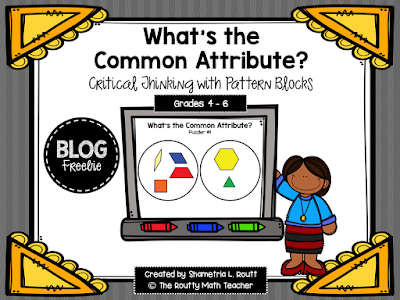
Thursday Tool School: Critical Thinking with Pattern Blocks


One the most common things I hear from teachers is about not knowing how to best utilize manipulatives. Many schools have a variety of manipulatives ready to be used, but they often go unused because teachers are unsure of how to use them to their fullest potential. Look no further. I'm got something special for you! 

Thursday Tool School will feature various math manipulatives that are common in schools. This weekly post will provide ideas for ways to get the most out of the tools. I will feature a new manipulative each month, so be sure to stay tuned. This month's featured manipulatives are pattern blocks. 

Pattern blocks. I know what you're thinking. When you inherited your classroom, there were gobs of these random shapes, maybe even a few buckets of them. You thought to yourself, "What am supposed to do with these? We only teach geometry and shapes for three weeks!" Well, did you know that pattern blocks can be used for more then just your three-week geometry unit? Pattern blocks can be used all year long! 

Here's a short explanation of the purpose of pattern blocks. A set of pattern blocks contains six basic shapes: a yellow hexagon, a red trapezoid, a blue rhombus, a green triangle, an orange square, and a beige rhombus. The pieces are proportional to each other which extends the number of ways in which they can be used. In addition to analyzing the characteristics of two-dimensional shapes, they can also be used to teach fractions. How's that for a non-standard fraction visual!

Today's activity involves critical thinking with pattern blocks. This activity can be used year round and makes a great starter activity, especially during that three-week geometry unit. The only prerequisite skills needed are some basic vocabulary terms related to shapes, i.e. sides, angles, congruent, equal, etc. 

Here's how the activity works:
1. Display the puzzler on a white board or wall.
2. Ask the students, "What's the common attribute?"
3. Provide think time.
4. Ask students to "turn and talk" to a shoulder partner, face partner, neighbor, or classmate to discuss the answer. 
5. Have students share their responses with the class. 

Important questions to ask: 
a. What vocabulary is important here?
b. What's the common attribute of the left side?
c. What's the common attribute of the right side?
d. What's the common attribute of the shapes in the middle, or the intersection, of the two circles? 
e. Why is there a shape on the outside of both circles? What does this mean? (It is a part of the set but does not meet the inclusion criteria for either circle.)


Once students get the hang of the activity, have them create their own puzzlers-- great menu activity. Using their creations, you validate your students as mathematicians and sense makers and expand your pool of puzzlers. 


Free Resource Alert: Grab a free pack of these puzzlers to get you started here or click the picture above. 


An InLinkz Link-up
This is a part of The Best of Teacher Entrepreneurs Marketing Cooperative's November Teacher Talk Link-Up


Tuesday, September 1, 2015

Transformation Tuesday: Assessment Strategies- Who's Correct?

Using a variety of ongoing assessment techniques is an important way to assess how students are progressing toward mastery of a concept or skill. Traditional methods include tests and quizzes; however, there are a host of other tools that will not only keep your students engaged but will also provide the feedback that you need to get a gauge on your students' understanding. 

Throughout the month of September, I will be offering suggestions for engaging assessment tools that you can use to fill your assessment toolbox. Today's strategy is called "Who's Correct?" This assessment tool allows students the opportunity to evaluate the mathematical thinking of others and either agree or disagree with the person's response. 


Here's how it works:

1. Present a problem to the class along with four characters’ answers and reasoning. 
2. Individually, have students determine who is correct and explain.
3. To share the responses, there are a few options: 
  • Designate one corner of the room for each character. Have students go to the corner that represents the response they chose. Give each corner an opportunity to discuss why they believe their character is correct. Then have each corner share their reasoning. (Note: Students must feel comfortable taking risks in order for them to reveal their real thinking. If you feel that your students would not be comfortable with this, choose another strategy, i.e. like the one that follows.)


Who's Correct- Assessing CCSS Math 5.G.B.3 and TEK 5.5
  • Designate one corner of the room for each character. Have students record the name of the character they believe is correct and their reasoning on an index card or a Post-it Note (no names). Students wad-up and toss the index card or Post-it Note to a place across the room. Have students retrieve a paper wad and go to the corner of the room that represents the answer. Give each corner an opportunity to discuss the responses. In turn, have each corner share the reasoning from their index cards or Post-it Notes. After all corners have shared, students can provide their own explanations and justifications for why their characters' response is correct or incorrect. At this time, allow students to change corners to match their new thinking. 
Note: The correct response should be revealed during the activity; however, if there is a large amount of disagreement, determine the misconception(s) and reteach the concept or skill. Additionally, if there is just a small group of students struggling to understand, record their names for a small group reteach session later. 

Variations: 

A. After students have selected the response they believe to be correct, have them provide a justification for why the other responses are incorrect. 

B. Assign each student a character's response and ask them to determine if the reasoning is right or wrong.

C. Use this task to review a troublesome problem on a multiple-choice test or quiz. 

D. Provide the students with three correct responses and one incorrect response. Then have the students determine whose response is incorrect. 

Who's Incorrect- Assessing CCSS Math 2.NBT.B.9 and TEK 2.4B
Free Resource Alert: The visuals I used above are available here. To use them with your students, insert the pictures into a PowerPoint slide. Then insert a text box with the responses you want to highlight.  


Monday, August 31, 2015

New Blog Structure

Hello Routty Math Teacher Community!

Today, I am introducing a new weekly blog structure. Each week, I will have three special features. I describe each feature in detail below. It's going to be a great school year! Happy Reading!

Great teachers, like you, are always looking for ways to improve their instruction and the success of their students. They attend summer professional development opportunities, they scour the web for new resources, and they regularly read teacher blogs searching for new ideas, strategies, and techniques. Transformation Tuesday was created for you! This weekly feature will highlight ways to increase student engagement in the classroom. Each month, I will change the focus. The month of September will feature ways to transform your classroom with engaging assessment tools.  


One the most common things I hear from teachers is about not knowing how to best utilize manipulatives. Many schools have a variety of manipulatives ready to be used, but they often go unused because teachers are unsure of how to use them to their fullest potential. Look no further. I've got something special for you! Thursday Tool School will feature various math manipulatives that are common in schools. This weekly post will provide ideas for ways to get the most out of the tools. I will feature a new manipulative each month, so be sure to stay tuned. 

The ability to solve problems using multiple methods is an essential skill students need to be successful mathematicians. NCTM (2014) advocates that "teachers must regularly select and implement tasks that promote reasoning and problem solving" so that students have opportunities to engage in "high-level" thinking (p. 17). In fact, research shows that "student learning is greatest in classrooms where the tasks consistently encourage high-level student thinking and reasoning" (NCTM, 2014, p. 17). The weekly Solve It! problem is designed to help meet these goals and provide teachers with an engaging task that will provide opportunities for students to reason about math and engage in high-level thinking. Additionally, students will strengthen their communication skills and learn to evaluate the mathematical thinking of others.  

Reference: 
National Council of Teachers of Mathematics. (2014). Principles to actions: Ensuring mathematical success for all. The National Council of Teachers of Mathematics, Inc.: Reston, VA. 

Sunday, August 30, 2015

Introducing the Routty Math Teacher's Teaching Tidbits-- a Monthly Newsletter

Hello Routty Math Teacher Community!

I'm excited to announce my new monthly newsletter with all of your favorite Routty Math Teacher features packed in one tidy, little package. The newsletter will be delivered during the first week of every month beginning in October and will include feature articles, teaching tidbits, math 'n' literature resources, and subscriber freebies. Plus, once you complete your subscription, you'll receive the link to a bonus freebie full of interactive notebook printables delivered to your inbox. You can grab your copy by clicking on the picture below.

Note: Your privacy is a top priority. Your email address will never be shared.

Friday, August 28, 2015

Blog Rewind: RACE and J.U.S.T.I.F.Y.


One of the tools I have found to be most successful for my students is utilizing a structure to analyze story problems. While I understand that some students do not need a prescribed structure, many students do not know how to analyze a problem and create a strategy solution plan of action. Using a problem solving model emphasizes the steps necessary to solve problems successfully. Over the years, my students have shown much success solving math story problems using my two favorite models. Click here to read my original post. Happy Reading!

Thursday, August 27, 2015

Blog Rewind: Use Bulletin Boards to Promote Challenge


A few years ago, I decided to start using the wall space in the hallway to extend the learning space of my classroom. After initially using the space to put up student work for a gallery walk, I began to make learning stations out there as well. This sparked an idea! I could create interactive bulletin boards to promote critical thinking and provide enrichment for my students. It was another opportunity to capitalize on my time and resources. Using a bulletin board, I had an instant station that was assembled all of the time. Click here to read my original post. Happy Reading!

Wednesday, August 26, 2015

Blog Rewind: Menus


A few years ago, I began using menus in my classroom to provide my students with an alternative activity for the fast finishers and math station seat work. It turned out to be one of my favorite activities! Using menus meant my students always had something on which to work. In addition, I was excited that the menus allowed me to include activities and projects that I was not able to fit within our regular class time. Most importantly, the students were excited about the menus and worked on them diligently throughout the grading period. Adding menus to my classroom was one of the highlights of the year and became a fun and engaging activity for the students. Click here to read my original post. Happy Reading!

Tuesday, August 25, 2015

Blog Rewind: Journals


Over the years, journaling has been the single most valuable tool for me in the classroom. While it can be time-consuming to assign and grade, the benefits of the task make it worthwhile. Using math journals in the classroom gives me a glimpse into what my students are thinking and where they are in the process of mastering the concept or skill that I am assessing. This single task can provide more information about a student's progress than any test or quiz. 

It's easy to start implementing journals in the classroom. Even if you only assign a handful of journal tasks this year, you will find the feedback useful for planning your next steps for instruction. Read about how I use journals in my math classroom here. Happy Reading!

Monday, August 24, 2015

Blog Rewind: After Math/ Book Activities


The very first post of the engaging mathematics series was about something I called, "After Math" and math 'n' literature book activities. Read about how to encourage your students to think about how we use math after class is over and how to support your grade level content and skills with math 'n' literature. Click here to read the post. Happy reading!

Sunday, August 23, 2015

Blog Rewind: August 24th - 28th

Hello Routty Math Teacher Community!

I can't believe it's been a whole year since I launched this blog page. What an amazing journey this has been! I have learned so much, especially considering I didn't even really know what a blog was when I started blogging for The Routty Math Teacher. In honor of my blog-a-versary, I am rewinding and highlighting some of the most popular posts from my very first series, Engaging Mathematics. So for those of you who are new to this community of readers, I hope you get some great ideas to use in your classroom. For those of you who have been frequent readers, I hope seeing these popular posts will inspire some new ideas for you as well. Check back each day this week for a new post. Happy Reading!

Friday, August 21, 2015

Kick Start Your School Year with Problem Solving

One of my favorite activities in the classroom is problem solving. It's such an important skill! We use it many times throughout our day without even thinking about it. In fact, this is a great introduction to problem solving-- make a list of all of the problems in your world you solved today or this week, such as what time to set the alarm clock for or how much time is needed to walk to school each day. Then have students discuss the strategies they used to make a decision. Create an anchor chart for these ideas and refer to them as they reappear in future discussions. Hopefully, students will begin to notice that they use some of the same strategies to solve problems outside of math class as they do inside it. 

I like to get started using problem solving in the classroom during the first days of the school year so that students understand the importance of it and that it will be a part of what we do every day. During math time, my problem solving component has two goals:
Click the picture for a free download.
  • Understand How to Analyze Story Problems- While the situations are not always authentic and the problems are generally more routine, I consider this to be a form of problem solving because the students learn how to analyze the problem for the parts needed to begin solving it. This not only supports the work we do to prepare for our state assessment, but it also provides a training ground for the more non-routine problems that I like to use. Depending on the grade level of the students, I use my RACE or J.U.S.T.I.F.Y. problem solving models to accomplish this goal.  
  • Solve Non-Routine Problems- These are my favorite type of problems to use in the classroom; however, they do require more time to allow the students to understand and then solve them. The understanding piece is aided by the initial process that I mentioned above. Non-routine problems are ones that cannot be solved by simply adding, subtracting, multiplying, or dividing to find the answer. They require students to develop and execute a plan of action and can often have more than one solution. 
With these two goals in mind, I try to integrate problem solving into what we do on a daily basis. Using this strategy, my students have multiple opportunities to use and expand their problem solving toolboxes, as well as, communicate with others about their thinking using math talk. 

This school year, I challenge you to integrate problem solving into your program at least three times a week. Increasing the amount of problem solving your students do on a regular basis will provide a great return on your investment. 

Here are some resources to get you started: 
If you have great problem solving resources to share, please include them in the comments below. 

Have a fantastic school year!

Thursday, August 20, 2015

Kick Start Your School Year with Math Talk

Using mathematical discussions in the classroom is a powerful way to increase our students' critical thinking and communication skills. However, what does effective math talk in the classroom look and sound like?

Today, I am guest posting for Rachel Lynette's "Minds in Bloom" website. So head on over to Rachel's website to explore ways to get your students thinking and communicating mathematically from the very first days of school. I've written a detailed article for you with lots of ready-made math talk resources to get you started. Happy Reading!


Wednesday, August 19, 2015

Kick Start Your School Year with Interactive Notebooks

Using interactive notebooks in the classroom is a trend that has gained popularity over the past couple of years. When coupled with foldables, interactive notebooks become great learning tools for students. If you perform a Google search for interactive notebooks, a wide array of websites and images will appear. If you're new to interactive notebooking, it can certainly be a challenge to get started. 

For my post today, I'm sharing how I like to do interactive notebooking, from the very first days of school. I consider the students' math notebooks to be their own student-created textbook. With that in mind, I only include items that have enough information to allow students to use their notebooks as reference tools. This means that each component must contain information that will support student learning outside of class. 


The polka dot ribbon is a bookmark that is taped to the inside back cover.
The pictures below illustrate how I set-up interactive notebooks at the beginning of the school year: 


While I haven't always included the "In Progress" envelope, it really helps when you have to end class in the middle of an activity and the students need a place to keep their work. Alternatively, the "In Progress" envelope could also serve as a place to place items that do not fit on a page very well, such as a rubber band book. 


I like for the notebook expectations to be front and center. Occasionally, I create these expectations with the students; however, I often just copy these expectations to use for better time management. 


In most years, I have the students create their own table of contents using the margins as their column dividers. However, depending on the age and ability level of the students, a reproducible table of contents works well too. 


The next few items are reference tools. I like to include them at the beginning of the notebook for ease of use. The first reference tool is the problem solving process that we use in class to analyze problems. (Note: You can find a free mini-pack with the J.U.S.T.I.F.Y. and RACE printables here or within the full versions at my Teachers Pay Teachers Store.)


I also include a copy of the problem solving strategies most appropriate for my students' age and ability level so that we can refer to them as we solve problems. (Note: You can download a free copy here.)


The operation situations illustrate the types of problems students encounter when solving story problems. At the beginning of the school year, we discuss visualizing story problems in the same way that we might visualize a book that we are reading. Once students can visualize the situation and create a mental picture of the actions that are taking place, they can begin to connect the actions to symbols. The operation situations tie the mental actions and the symbolic representations together. (Note: You can find the full-size version of these pictures in my Teachers Pay Teachers Store.)


In Texas, students are given a reference chart to use on their end-of-the-year state assessment. So that my students are proficient at utilizing this tool, we practice with it all year long. Having a copy available in their math notebooks keeps the learning tool accessible at all times. 


In order to get a better feel for my students' needs, I like to complete a learning preferences checklist during the first week of school. The information provides me with valuable feedback about my students and their learning needs. 


After completing the survey, students create a bar graph with their individual results. This gives us an opportunity to begin graphing right from the start of the school year.


This last piece gives the students an opportunity to get creative and show-off their individual style. I give students a guideline for how to format the page and a list of statements to get them started, but the creativity level is left entirely to them. 


I enjoy using interactive notebooks with my students every year. Having the opportunity to create their own unique "textbook" gives them some choice in how to create a learning tool that will best meet their needs. Set-up does take several days, but it is well worth the time!

I would love to hear how you use interactive notebooks in your classroom.  Please share your thoughts in the comments. 

Note: Like the printables you saw in the pictures? Stay tuned for more information about how to get a copy of this resource.

Tuesday, August 18, 2015

Kick Start Your School Year with Estimation 180


One of the new resources I have been exploring over the past few weeks as the result of my involvement in Math Rocks, a community of teachers in my school district working together to build relationships and spread the love of math, is Estimation 180. This website includes a plethora of images from the real world where students have to estimate some figure in regards to what is represented in the picture. For an example, see the picture below. 

The website is organized by days. As of today, the site is up to 220 days; therefore you could use this website everyday for 220 days and get a different picture each day. Wow! 

Here's how it works: 
1. Choose an image.
2. For each image, have students answer the following questions:
  • What estimate is too low?
  • What estimate is too high?
  • What is your estimate?
  • What is your reasoning? Begin with, "I noticed . . ."
One of the other teachers in the Math Rocks community used the phrase "Mathematize Your World" to describe what is happening in these images. I love this phrase because that's exactly what students are expected to do. They are looking at ways that we use math in our everyday lives. How many times, looking at Image B, have we looked at a large container of something and needed to estimate how many smaller containers could share the contents of the large container? First day of school snacks, i.e. Goldfish? Estimation is part of what we do everyday.

This activity is an excellent opportunity to encourage students to communicate their thinking to others in pairs or small groups. After allowing students some think time to answer the questions above, allow students to share their reasoning with others and then do a class share-out. I'm not sure about you, but I just thought of a new starter-- Mathematize Your World Monday with Estimation 180. 

Not only does the website provide rich opportunities for students to use their estimation skills and discuss the reasoning they used to arrive at their estimation, but the website uses a Google form so that students can share their estimations with the world. Estimations could be submitted as a class, after agreeing on the estimation to submit, or individual students can submit their own estimations. After submission, students can access the contributions of others via the form results sheet. And yes, the correct answer is revealed during this process. 

Monday, August 17, 2015

Kick Start Your School Year with Starters


As we well know, our teaching minutes are precious. Every minute must count! Using starters offers an additional opportunity to get your students thinking mathematically from the first moments of class-- the best moments because it's a chance to "hook" your students right from the start. 
Number of the Day

Starters are critical thinking activities designed to get the students thinking about math and provide opportunities to "sneak" in grade level content and skills in a fun and engaging way. Designed to take no more than 5 minutes of instructional time, starters can include a variety of tasks. In order to get the most out of the time, I have a different starter for each day of the week. Here's an example of my most recent schedule for starters:

Number Sense Tiling Task
  • Monday- Number of the Day
  • Tuesday- Critical Thinking Task (usually involving the use of number tiles)
  • Wednesday- Today's Number
  • Thursday- Vocabulary
The above schedule is most recent, but I tend to change this schedule depending on the needs of my students. 

The list of options for starters is endless. Here's a list of some of my favorites: 
I love to challenge my students to complete these mental math operations faster and faster each time! Having four problems per card gives you four games in one. Find it at my TpT store! For a free, single problem version of this pack, subscribe to this blog (enter your email address under "Join the Routty Club" on the right sidebar). 
Click the pictures below to view a free version of the following resources. 
Back to School Math Starters
You can also find additional starters in the "Critical Thinking" section of my "File Cabinet."